THE WRITTEN REPUBLIC
The rules on paper.
Constitutions, laws, rights and public institutions define the formal promise of a society: the responsibilities we carry and the protections we should expect.
 Early edition
THE BOOK · THE IDEAS · THE EMERGING MOVEMENT
In the rules we follow. In the institutions we trust.
In the ordinary choices that shape a nation.
A home for The Everyday Republic—and for the question at its heart: how do responsible citizens and accountable institutions build a society that works?
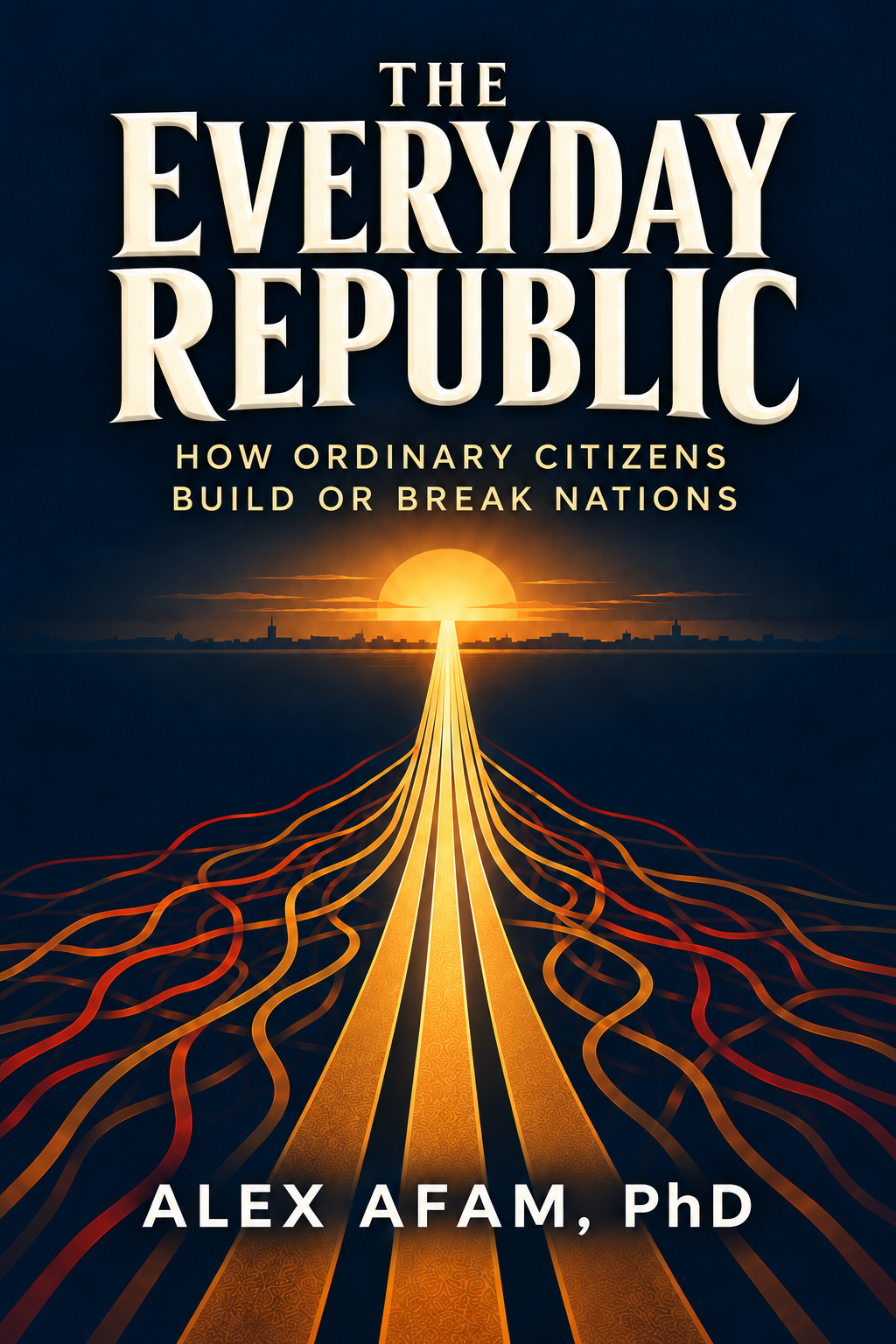
THE CENTRAL THESIS
One sets out how society should work. The other is revealed in how we live together.
THE WRITTEN REPUBLIC
Constitutions, laws, rights and public institutions define the formal promise of a society: the responsibilities we carry and the protections we should expect.
THE EVERYDAY REPUBLIC
At a junction, in a queue, on a pavement or behind a public desk, our habits and expectations reveal whether that promise is credible.
The distance between what a rule intends and what a citizen actually experiences.
See the gap in ordinary life“We must explain the system without absolving the individual, and demand individual responsibility without ignoring the system.”
From the introduction, The Everyday Republic
THE EVERYDAY EXPLORER
Choose a scene, then follow the relationship between what citizens do, how institutions respond and what reform might change.
A driver waits. Another crosses. The signal is the same; their expectations of the rule are different.
An interpretive guide to the book’s themes. Reform ideas are prompts for investigation and discussion, not claims of tested impact.
INSIDE THE BOOK
Nineteen chapters across five parts. Follow the argument in sequence, or find a theme and begin there.
19 CHAPTERS
A VOCABULARY FOR THE REPUBLIC
The book’s concepts connect ordinary experience to the systems that shape it.
The livelihoods, businesses and practices that emerge around systems that do not work as they should.
Benefiting from dysfunction does not, by itself, show that someone caused it or wants it to continue.
THREE RELATIONSHIPS TO DYSFUNCTION
The distance between the intended rule and lived reality. Ask what the rule promises, what happens in practice and how the gap becomes accepted.
A provocation about certification that loses its purpose. A licence should give the public meaningful assurance of competence; a document alone cannot do that.
Citizens carry responsibilities and may expect institutions to protect rights, apply rules fairly and act consistently. Responsibility and accountability belong in the same conversation.
The extra money, time and tied-up resources used to compensate for systems that fail. It is an analytical concept, not a formal tax or a quantified finding here.
RESEARCH & SURVEYS
Observation opens an inquiry. Interviews, surveys and reading help distinguish a vivid scene from a defensible claim.
What is its purpose? Who benefits from it? Is the expected behaviour clear, practical and fair?
Ask citizens what makes compliance difficult. Ask officials what makes consistent, fair enforcement difficult.
Compare observations with documents and other accounts. Record exceptions, uncertainty and what the evidence cannot establish.
“What would need to change for following this rule to become the normal, reasonable choice?”
Eight draft questions for reviewing how to ask about behaviour, fairness and trust. This is a draft questionnaire workshop; it displays no collected findings.
Answers are optional. They stay in this browser until you export them. No names or contact details are requested, and nothing is submitted to TERI.
Selected works already cited in the manuscript, offered as reading routes. This is not a claim that they establish every interpretation on this site.
Trust: The Social Virtues and the Creation of Prosperity (1995)
How shared expectations support cooperation.
Institutions, Institutional Change and Economic Performance (1990)
Formal rules, informal constraints and incentives.
Understanding Institutional Diversity (2005)
How people organise collective action.
Why People Obey the Law (2006)
Fairness, legitimacy and voluntary compliance.
FROM A BOOK TO A CIVIC PURPOSE
The Everyday Republic Initiative—TERI—is the emerging organisational expression of the book’s civic vision.
Its draft vision is a society in which responsible citizens and accountable institutions work together to build an orderly, just, productive and inclusive nation.

Translate rights, duties and everyday rules into discussions and learning resources that people can use in communities, workplaces and campuses.
Working question: Which ordinary scene would make the best starting point for a civic conversation?
Develop careful research and peaceful, constructive dialogue among citizens, institutions, businesses, civil society and the media.
Working question: What evidence would help each participant understand the others’ responsibilities?
Explore small, observable efforts that connect citizen responsibility with institutional response. Define the problem and how learning would be assessed before a pilot begins.
Working question: What would reliable everyday function look like in one shared space?
Responsible citizenship · Integrity · Service · Accountability · Political neutrality · Constructive partnership · Evidence · Inclusion & mutual respect
YOUR WORKING NOTEBOOK
Capture a scene, an uncertainty or a reform idea to return to.
Notes are saved in this browser only.
Export a copy to keep them elsewhere.
This website introduces the ideas behind The Everyday Republic. Chapter descriptions and interactive scenes are guides to its themes, rather than the full manuscript. The manuscript is complete and is being prepared for publication; purchasing details will be added when available.
The Everyday Republic Initiative (TERI) is a proposed civic organisation. CAC registration remains pending. Its vision and programme directions are being developed.
Survey questions and reform prompts are discussion drafts, not research findings. Notebook entries and survey answers stay in your browser; they are not submitted to the author or TERI.
Download the website QR code (PNG) · Print-quality QR code (SVG)